
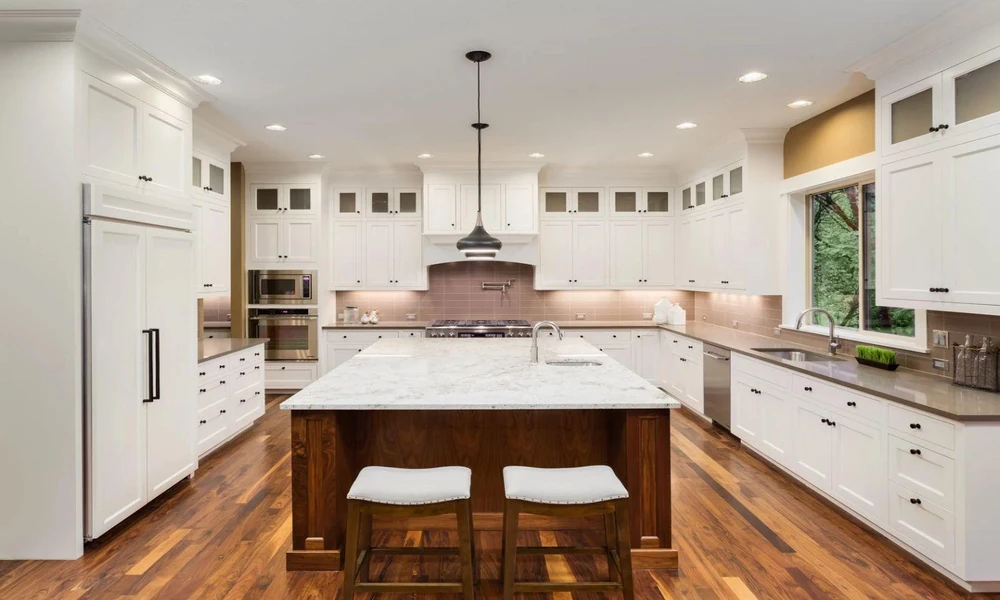

Watch where people go at a gathering and it is never the dining room. They drift toward the kitchen and settle in around whatever surface is nearest the host.
An open-concept kitchen simply accepts that and builds around it. Done well, the cook stops being isolated behind a wall and becomes part of the evening, which is the real luxury in a modern layout.
Designing the Island as the Hub
An island earns its keep when it does several jobs at once without those jobs colliding.
The usual answer is zoning. Prep happens nearest the cooktop and sink, serving platters land on a stretch kept deliberately clear, seating sits at the far end away from hot pans and knives, and a beverage station with its own small sink keeps guests from reaching across the work area for ice.
Seating comfort is worth more attention than it usually gets. Counter overhang determines whether people can tuck their knees under and stay a while or perch awkwardly for a few minutes before wandering off.
Lighting changes the mood more than any finish. Bright task lighting over the work surface for cooking, something warmer and dimmable over the seating, a low glow left on once the plates are cleared, and the ability to move between them is what carries a room from dinner prep to midnight conversation.
Planning the Flow Around the Cook
Open-concept layouts fail in one predictable way. Guests end up standing exactly where the host needs to walk.
Clearance is the fix. Generous aisles on the working side, a path to the refrigerator that does not cross the cooktop, a landing spot near the oven for hot trays, and a route to the outdoor space that avoids the prep zone all keep traffic moving without anyone having to ask.
Ventilation deserves a mention too, because in an open plan there is no door to close. A quiet, properly sized hood keeps the smell of seared fish out of the sofa cushions, and quiet matters as much as power when people are talking nearby.
Sound is the other thing open rooms expose. Hard surfaces bounce noise, so soft-close hardware, rugs in adjoining areas, upholstered seating and textiles at the windows all take the edge off a lively room.
Choosing Surfaces That Survive a Party
This is where the design partner matters, because material choices look similar in a showroom and behave very differently at a dinner party.
Firms such as Armina Luxe, which designs Italian cabinetry and coordinates stone sourcing from its Miami Design District showroom, are worth evaluating on whether they produce photorealistic renderings before anything is fabricated, how they specify joinery and finishes for South Florida’s humidity and salt air, whether stone and cabinetry are coordinated by the same team, and what support looks like after installation. Ask to see work in person, since a finish reads differently in a real room than on a screen.
Countertop choice deserves candor, especially for a kitchen built around entertaining. Marble is beautiful and etches, and the usual culprits are red wine, citrus, vinaigrette and anything else acidic left sitting. Quartzite and porcelain hold up to that kind of evening far better.
Many clients split the difference. Marble where it will be admired, something tougher where the glasses and cutting boards actually land.
Getting the Details Right Before Build
The difference between a kitchen that entertains well and one that photographs well is decided in the planning stage.
Storage carries a lot of it. Deep drawers for serving pieces, a dedicated spot for platters that only appear on holidays, concealed small appliance storage, and a place for recycling keep an open kitchen from looking cluttered when the room is also a living space.
Outlets and charging points belong in that conversation as well. Nothing interrupts a gathering faster than someone hunting for a plug behind the sofa.
A kitchen like this never quite finishes being tested, and that is the pleasure of it. Friends arrive early, the island fills with glasses and half-finished plates, somebody takes over the music, and the host is standing right there in the middle of it rather than listening from another room.


Leave a Comment